Wednesday, March 24, 2021

The Ultimate Gold Panning & Prospecting Guide

Excerpt From The ProspectorsJournal.com 


Gold panning is a really fun hobby that is enjoyed by people all around the world.

And it isn’t just hobbyists that use a gold pan to search for gold. Even experienced miners with a lifetime of experience with placer mining use them to quickly sample new areas and seek out concentrations of placer gold in creeks and rivers.

There is abundant information about gold panning on the internet… in fact, a while back we wrote this simple Step-by-Step Gold Panning Guide to help teach people the proper steps to use your pan.

However, we felt that a more expansive guide was needed to go beyond these simple steps in the gold panning process. There is a whole lot more involved in successfully finding gold than just using your pan properly.

Most of the people that go gold panning never find any gold. This is a fact. And their panning technique isn’t necessarily the problem… instead it likely has to do with the material that they are panning.

So let’s take a more in-depth look at successful gold panning so you can be sure to successfully find gold next time you go to your favorite river.
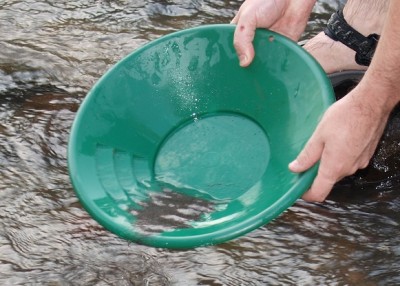
gold panning guide


Choosing the Proper Gold Pan

First, let’s talk about the proper equipment, and of course the first thing you need is a good gold pan. There are lots of different pans out there, and all of them will work to varying degrees. After all, the panning process relies on gravity more to capture the gold, so theoretically ANY type of pan shaped object that had a low point would work to retain gold. In fact, miners during the early gold rushes in the 1800s used all sorts of homemade metal pans to get the gold.

Of course, today there are commercially produced gold pans that are do a really good job, and are a huge improvement when compared to what the “old timers” used back during the gold rush. And the first mass-produced pans were made of steel, which needed to be “cured” to remove factory oils before they could be used. Additionally, they would easily rust if not properly cared for.

A modern plastic pan has many advantages over the old metal pans that were popular years ago. The plastic gold pans that are made today are very durable, come in colors that contrast well with gold so that you can easily see the tiniest specks in the bottom of your pan, and they have built in riffles that aid in retention of the finest little bits of gold.

There are lots of good pans out there today, and one really good one is the Garrett Gravity Trap. It is my personal go-to pan for most situations. It is inexpensive and durable, and does a fantastic job of retaining fines.


Other Equipment to Have When You Start

To successfully pan for gold, you’ll need to carry more gear than just a pan. In fact, a good quality gold panning kit can really increase your odds of success when you start panning (This Garrett Gold Pan Kit has some good stuff to get you started).

You should still add a few more tools to your arsenal though if you want to be well equipped for a day on the river. Of course a good ol’ #2 shovel is a must-have item, and a smaller trowel sized shovel is also a pretty good idea.

Other good stuff to carry would be tweezers, magnifying glass, and a variety of crevicing tools that you can use to dig material out of cracks in the bedrock.

Crevicing tools don’t need to be store bought items specifically designed for prospecting; to the contrary, some of the handiest tools for this can be things like screwdrivers, thick pieces of wire, spoons, and pocket knives. The more variety you have, the better job you can do to get down to where to gold hides.


Where to Get Your Gravel

So what am I talking about when I say “where the gold hides?”

Well, I think most people know that gold is heavy; in fact it is generally the heaviest element that you will find in a river. What that means is that gold settles down, way down. And it settles in places where gravity allows it to.

Most of the gravel in that bar is barren and devoid of gold. Even if you are prospecting at a well-known gold-bearing river, the gold isn’t scattered around randomly, so if you simply dig a few shovelfuls of gravel from the top of a gravel bar and pan it out, you probably aren’t going to have any success.


Inside Bends and Behind Boulders

There are many places where gold can hide, but one universally understood truth is that gold will concentrate in “paystreaks” on the inside bends of rivers and streams. These are the areas where gravity allows the gold to settle.

Behind large boulders is another great place to get gravel to pan out. In the same way as inside bends, the slack water that is created behind large rocks and boulders can create conditions that placer gold can drop down and settle into the stream bed.

Boulders are great, but really any structure can have the same effect. For example, a seasonal logjam could easily create a similar environment where gold would settle.


Dig Deep and Clean out That Bedrock
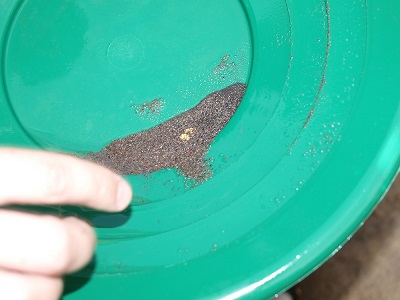
placer goldMost prospectors understand that inside bends and behind boulders are good places to dig. However, this is the point where LOTS of first time gold panners mess up.

They need to DIG DEEPER!

You know how gold settles to the bottom of your gold pan when you agitate it, right? Well the sands and gravel in a river or creek is doing this CONSTANTLY. The result is that as soon as gold finds a place where it settles, it starts to move downward in the strata of the gravel. It goes down, down, down, until it hits something hard enough to stop it. And this is generally bedrock.

Clean out those bedrock cracks. This is where those crevicing tools I mentioned earlier really come into play. Do your best to get down as deep as you can, because the highest concentrations of placer gold area going to accumulate at the very bottom of these cracks.

Oftentimes, it will be a thimbleful of material at the bottom of a bedrock crack that is richer than a hundred shovelfuls of gravel just a few feet above it.


You Should Spend Way Longer Getting Your Gravel than You Do Panning


Ultimately, I think this is the main reason that many prospectors will have a lack of success with gold panning. First-timers generally get excited to start finding gold, so they start digging indiscriminately all over the place, filling up their pan and going through the motions without actually seeking out the places where gold is most likely to be found.

Most of the time, getting down to bedrock is no easy task. Depending on the area you are panning, there can be considerable overburden that covers the bedrock, and it can take a lot of time and effort to get down to the good gold-bearing gravels.

But if you don’t go to the extra effort to access these richest areas, then what is the point? You do want to find gold, right?


Classify Your Material Before Gold Panning

good Gold Panning Kit should include a classifier. This is some sort of screen that is used to filter out the larger material.

Remember, most gold that you find is tiny. The vast majority of gold is dust and small “pickers” that are less than ¼” in diameter. Finding a gold nugget by panning is a rare occurrence, so classifying out the larger rocks and gravel that is highly unlikely to be gold is a good idea. There’s no sense wasting space in your gold pan with large, heavy rocks that almost certainly don’t contain any gold.

Classifying does a couple things. First, it removes those larger rocks that aren’t gold. Before you toss them aside, it’s always a good idea to give them a quick look-over to make sure that you’re not pitching a big gold nugget or specimen out, but most of the time it will just be gravel.

Rather than worry about inspecting all of the larger gravel that you toss aside, you could just leave it in a pile and scan it with a high-frequency gold metal detector after you are done to make sure that nothing good was tossed out.

The second benefit of removing the larger material is that the gravels in your pan will stratify more evenly if it is all of uniform size. This will help ensure that fine gold will easily settle down to the bottom of your gold pan, and it will stay there throughout the panning process.


Put a Moderate Amount of Gravel in Your Pan

Loading way too much gravel into a gold pan is another mistake that lots of prospectors make. For one thing, it makes your gold pan really heavy, which can get really uncomfortable during a long day prospecting on the river. When you are uncomfortable, you are more likely to get sloppy with your panning technique, so only put a moderate amount of classified gravel into your pan at any given time.

This would also be a good time to mention that you use a gold pan that is of proper size for you. For most men, a 14-inch pan is a good universal size. For women and kids, smaller 12” and even 10” pans might be the best size.

Sure, a bigger pan can hold more material, but they sure get heavy after you fill them up. Personally, my back and shoulders are a lot happier if I use a reasonably sized pan and work at a reasonable pace.


Get Everything Wet and Break it Up with your Hand
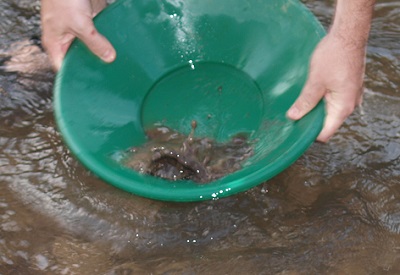
panning for goldAlright, let’s get down to the nitty-gritty of gold panning! You’ve now got some gravel in your pan and you want to start working it. The first thing you need to do is dip your pan in the creek and get some water in there to completely saturate the gravel in your pan.

Now, BEFORE you do any panning, get your hands in there and bust up any clumps that you feel.

Clay is the enemy of the gold prospector!

It can capture and hold small gold particles, pulling it out of the pan. You want to bust up any clumps of clay that you feel, and in general just make sure that everything is loose and separated. This will allow any free gold particles to settle into the bottom of the pan the way that they are supposed to.


Agitate Vigorously Before Tipping the Gold Pan

Now that you have everything loosened up in the pan, it’s time to start shaking it up, but don’t tip the pan yet. You want to give the gold a chance to get down to the bottom of the pan where you want it.

Continue to agitate the contents of the pan, and you will see that the larger, lighter weight pebbles (with a lower specific gravity) will rise to the top. This is a good sign. This shows us that the contents within the pan are starting to stratify, which is exactly what you want to happen.

Tip the pan, and slowly work it allowing lighter gravels to leave the pan

At this point, any gold that is in your pan should be settled to the bottom, and as you slightly tip the pan and continue agitating the contents the gold will end up in the bottom crease of the gold pan.

Now you can start letting some of the gravel to slowly leave your pan.

Do this process SLOWLY!

You’ve gone to a lot of effort at this point to make sure that you have good material in your pan, and you don’t want to get sloppy now.


Make Sure you are Panning over the Riffles

A gold pan like the Garrett Gravity Trap has several riffles that help to retain gold from falling out of the pan. In theory, you really shouldn’t need these at all, since a careful panning process should ensure that the gold never leaves the bottom crease of you pan. Still, you want to makes sure that your pan is oriented correctly so that the sand and gravel that is leaving your pan is going overtop these riffles. This is a little added “insurance” that you aren’t losing any gold out of your pan.


Tip Upright and Repeat Upright Agitation Several Times Throughout the Process

As you continue to add water to your pan and slowly pan out the contents of your pan, it is very important that you tip your pan fully upright and repeat the initial step of agitating the contents so that the gold will re-settle down to the bottom. It can even be a good idea to put your hands in there again and continue to break apart anything that feels like it’s sticking together. This is especially true if your material has a high percentage of clays.


Continue Until you have just a bit of the Heaviest Materials in the Pan

Continue this process until almost all of the lighter material has been washed out of the pan. This process will take several minutes, so don’t get too hasty and try to get it done quickly. Once you have gotten down to just a few pinches of material at the bottom of your pan, stop what you are doing and take a look at the contents.

Almost all areas (especially places that are known to have gold) will have some amount of what is generically called “black sands.” Black sand can actually be a variety of different minerals, but are most commonly made up of hematite and magnetite. These both have a heavy specific gravity and will show up at the bottom of your pan in most areas.

Also Read: Mercury Amalgamation and Fine Gold Recovery

And: Removing Fine Gold from Black Sands

Sometimes there will be other small minerals of various colors that you will see. Garnets are another gem that will often there. They are usually a deep red/purple color. Once you’ve reduced the contents of your gold pan to just these minerals, stop and take a closer look.


Visually Inspect the Contents and Look for “Pickers”
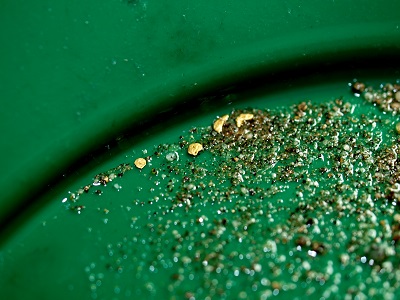
gold and black sandThe first think you want to do is take a quick look amongst the black sands and see if you can spot any visible nuggets or “pickers” of gold. Remember, these aren’t likely to be big chunks, but rather little flakes that stand out within the black sands. Casually shake the pan while you look at the contents, looking for any bits of gold that may be exposed.

This is the when having a colored gold pan is really nice, rather than an old metal pan. The newer plastic pans that are green create a nice contrast with the gold that is in your pan, and often the little bits of gold can really stand out.

If you are fortunate enough to spot a nice picker, it is now a simple task of using tweezers to pick it up and drop it into your vial (hence the term “picker”).

It’s always a nice surprise to recover a good sized piece of gold that you can grab with your tweezers. Most of the time it’s too small to grab, so there are a few tricks to help you separate the fine gold from the remaining black sands so that you can capture it and add it to your vial.


Use a Magnet

Some (but not all) black sands are magnetic, so using a very strong magnet can really help to separate it out. There are special magnets that are designed for this task that are reasonably priced that do a great job.

Just be aware that sometimes gold can cling to black sands that you pick up with you magnet, so it’s a good idea to take your reject black sands and keep them in a bucket to look over a second time before you toss it out. It is very easy to lose some gold in this process, so take your time and be sure to look over everything carefully to make sure you are getting all the gold.


Tilt your Gold Pan and Shake it Very Slightly to Create a Line of Stratified Minerals

Doing this final step in the panning process can be a little tricky and frustrating or beginners, but it is really the step where you can expose the tiniest of the fine gold particles that may still remain hidden at the bottom of your pan. You can separate the gold from the black sands with carefully agitating the contents that are left. Tilt the pan just slightly and shake the pan in a very gentle motion. If done correctly, you can get a nice stratification of light to heavy materials, and the gold will show up at the trail end.

Another tip that you can do at this final step is to do a quick flick-of-the-wrist, enough motion that all of the garnets and black sand will move, but the gold will remain in place. This can be challenging at first, but a little practice will improve your skills. And it can be really fun surprise, because it will immediately expose any gold that was hidden beneath the sands.


Use Snuffer Bottle

fine gold dustThe very last step to pick up the finest of the fine gold is to use your trusty snuffer bottle. A good Gold Panning Kit will include one. With a snuffer, you can carefully shoot water over top of your concentrates, which blows the black sands aside while leaving the gold.

When you’ve got the fine gold completely separated, you simply suck it up with your snuffer bottle, which can later be transferred to your vial.


Conclusion

I hope this article gave you a bit more information than just the simple “how to” information that is out there. While learning the proper steps of gold panning is important, it really is the entire process that starts with getting the proper equipment, looking in the right places, and putting good quality material in your pan before you even begin.

If there is one bit of information that you should take away from this article, it would be that you need to spend more time worrying about where you get your gravel, rather than the panning technique itself.

Even the poorest panning technique will yield some gold if you are searching in the right areas, but you can’t make gold magically appear in places that it doesn’t exist! So take that extra time needed to find quality gold-rich material.

Happy gold prospecting & mining!

Submitted By Michael Webster 

Blogger: User Profile: Michael Webster

www.blogger.com/profile/16089681464802136846

Michael Webster is publisher of the Laguna Journal, Small Business Journal, Indian Gaming Journal & El Paso Journal, Prespectorsjournal.com on line newspapers and a Syndicated Investigative Reporter Michael Webster Syndicated Investigative Reports are read worldwide, in 100 or more U.S. outlets and in at least 136 countries and territories.

Michael (Mick) Webster's Blog - Constitution Club

constitutionclub.ning.com/profiles/blog/list?...

Michael (Mick) Webster's Blog | The goal of the Constitution Club is to create networks of liberty minded patriots in each of the over 3,000 counties in the Un

Tuesday, March 16, 2021


Biography

Michael ( Mick) Webster

Sr. Safety Specialist, Author, Investor, Newspaper Publisher and Syndicated Investigative Reporter


BIO Michael ( Mick) Webster publishes the oldest online newspaper the "Laguna Journal". Mr. Webster's Syndicated Investigative Reports are read worldwide, in 100 or more U.S. outlets and in at least 136 countries and territories. He publishes articles in association with global news agencies and media information services with more than 350 news affiliates in 136 countries. He served as a trustee on trade Union funds. He is a business investor & consultant. A noted Author, Lecturer, Educator, Emergency Manager, Counter-Terrorist, War on Drugs and War on Terrorist Specialist, Newspaper Publisher. Radio News caster. Labor Law generalist, Teamster Union Business Agent, General Organizer, Union Rank and File Member Grievances Representative, NLRB Union Representative, Union Contract Negotiator, Workers Compensation Appeals Board Hearing Representative. Mr. Webster represented management on that side of the table as the former Director of Federated of Nevada. Mr. Webster publishes the following on-line newspapers: www.lagunajournal.com www.smallbusinessjournal.com www.prospectorsjournal.com www.indiangamingjournal.com www.elpasojournal.com, and does investigative reports for print, electronic and on-line News Agencies.


Mr. Webster is America's leading authority on Venture Equity/Debt Funding,( Venture Capital by Michael Webster (Author) Trustee on some of the nation’s largest trade Union funds. He is the author of “Venture Capital” and four other new best sellers list. He has helped top executives, average investors and entrepreneurs find capital for start-up and expansion projects and show clients how to maintain and preserve that capital.


Mr. Webster is known and highly respected as a Safety Consultant. Some resent projects he has worked on include 3.0 billion LA County Metropolitan Transit Authority Senior Safety Specialist Purple Line – West Side Extension. $2.7 billion LAX People Mover project. Emergency Manager for Federal Emergency Management (FEMA). He continues to receive confidential calls (questions) from various government (not just U.S.) officials, General Contractors, Sub-Contractors, Builders, Corporate Staff members and Business Owners.


Mr. Webster was a very early advocate that the Indian Nations create and develop Indian Casinos. The purpose and aim was helping to improve the living conditions and the lives of American Indians on reservations. Starting with the Mescalero Apache “Inn of the Mountain Gods” in the state of New Mexico where he served as Head Of Safety.


Mr. Webster has been called the Jack London of finance for his ability to cut through the icy myths and mysteries surrounding the world of financing and putting deals together and lead entrepreneurs successfully into the 21st century. Mr. Webster's experience spans over three decades and includes being on the board of several renown organizations & associations. He is also the author of, the Christian Covenant, the RedRoad, the LemonFast and the United States Civil Defense Emergency Training Manual.


Mr. Webster has Collaborated on a Community Emergency Response Team (CERT) course having over 300 plus pages with color text and full color power point presentation. (Survival Family Emergency Response & Preparedness Guide ).


Mr. Webster was the founder in the 1960’s and 70’s of “Paramedic’s On Call” and was one of the earliest providers of Emergency Paramedic services in the nation and become known as the Father of emergency care and transportation of the sick and injured. He was also directly responsible for Doctors to be on site in hospital emergency rooms throughout E Paso for the first time ever, when up until that time Doctors were not in the emergency rooms at the hospitals but were simple on call. He appears frequently on TV and can be heard on Radio nation wide and speaks at major Safety/Financial/Terrorism conferences worldwide.


Mr. Webster instructs cities and counties home defense volunteers on FEMA'S Community Emergency Response Team course (CERT) and provides emergency planning for governments, private companies and corporations, globally. He also teaches experts how to follow the money trail of terrorist.


Mr. Webster has had business dealings with such notable financiers, professionals and entrepreneurs as, billionaires Aristotle Onassis, Howard Hughes; J. Paul Getty; H.L. Hunt; Founder of Circle K Corporation Fred Hervey, President Lyndon B. Johnson, U.S. Senator Lloyd Benson, U.S. Senator John G. Tower, U.S. Senator Ted Stevens, U.S. Senator Howard Cannon, Former Texas Governor John Connolly, Former Texas Governor Mark White, Former Governor of Alaska and U.S. Secretary of the Interior Wally Hickle, former Alaska governors William A. Egan, and Keith H. Miller, Lt. Gov of Alaska and former Mayor of Fairbanks H. A. Red Boucher, U.S. Congressman Richard White, U.S. Congressman Jim Santini, Alaska State Senate President Brad Phillips, Alaska Attorney General, Edgar Paul Boyko, Texas State Representative Bill Clayton, Attorney Melvin Belli, Attorney Oscar Goodman & former Mayor of Las Vegas, Attorney Albert C.S. Ramsey, Attorney Joseph (Sib) Abraham, Attorney Joseph Morgan, Attorney Jerry Seiberling, Attorney C. Thomas McDonald, former Texas State Senator: Tati Santiesteban, Judge Woodrow Wilson Bean Sr., Judge Woodrow Bean Jr. Veteran Broadcaster David Brinkley, Wendell Chino Chief of the Mescalero Apache Indians of New Mexico, Labor union leaders: Harry Bridges, Jimmy Hoffa, and Alaska teamsters boss Jess Carr.


Mr. Webster is the original founder of WIB Financial Group (www.wibfinancialgroup.com , and over the years, has invited such notable investors and entrepreneurs as billionaires Bill Gates, Warren Buffet, Richard Branson, and Donald Trump (to name a few) to participate in Mr. Webster's worldwide consortium of investors.


Mr. Webster was formerly an official with the Teamsters Union in California, Texas and Alaska.


Mr. Webster is a Venture equity/debt funder source and business consultant, Author, Journalist, Investigative Reporter, WCAB Hearing Representative, Counter Terrorist Specialist and Instructor, Emergency Management Specialist and Instructor, Sr. Safety Specialist, Emergency Medical Tec (EMT), Wildland Fire fighter and Instructor, Adventurer, Explorer, Holistic Nutritionist and Amateur Anthropologist.


Mr. Webster has been described as an entrepreneur extraordinaire and a businessperson’s businessperson. Since the tender age of 6 when he sold Spud-Nuts (made out of potatoes) door-to-door in the city of his birthplace, El PasoPaso, Texas. He was born at William Beaumont Army Medical Center, the son of a US Army Officer. Both parents, Albert A. Webster (Father) and Leona Allene Webster (Mother), said, Michael showed at a very early age an interest in commerce and became keenly involved in various businesses. He always seems to look out for the underdog, said his mother.


Mr. Webster supervised on site mitigation of life threatening emergencies including disasters and major relief efforts both here at home, and around the world. He is also active in church and civic organizations. He is the loving husband of Peggy Webster (the former Peggy Rae McDonald) and the proud father of Michael Vincent II, Heather Rae, Renee Marie, and Ronda Ruth Webster, and Vincent, Vance, and Riza Christy.


Mr. Webster’s most recent field of endeavor is that of a venture equity/debt investor, business and safety consultant.


Mr. Webster funds or finds founders for start-up and expansion businesses here at home and around the world, while retaining equity positions in many of them. Mr. Webster also provided his clients with bulletproof asset protection. He is also dedicated to journalism as a syndicated Investigative reporter. He will maintain his other interests in buying & selling businesses, workers advocate, labor relation issues, worker’s compensation, micronomics, safety, emergency management, preparedness and anti-terrorist activities. As well as teaching and sharing in those areas and disciplines. Over the years he has consulted and negotiated on behalf of his clients through five different administrations. He publishes newspapers and magazines and has been a newscaster in the electronic media. As a hearing representative for California's Workers Compensation Appeals Board he represents lien claimants and has recovered millions of dollars for his clients. He still finds in his busy schedule time to develop and write investigative reports.


Mr. Webster has served as administrative Assistant to the president of the Alaska State Senate. He was formerly Executive Director of the Alaska Independent Oil & Gas Association (A.I.O.G.A.) serving under the direction of its founder and Statesman Edgar Paul Boyko, ( the states former Attorney General). Mr. Webster was instrumental in raising bonus capital in the millions for bidding on the Alaska Northslope Oil Leases in 1968, as director of A.I.O.G.A. A.I.O.G.A. was awarded Tracks 20 & 21 estimated known value of approximately $66 million each, by then Alaska Commissioner of Natural Resources Thomas Kelly, as the apparent high bidders, only later to be rejected by the Commissioner. This lead to one of the largest behind the scenes legal battles ever to involve A.L.O.G.A., their lead attorneys, Edgar Paul Boyko (former Alaska State Attorney General), famous attorney Melvin Belli, and former Judge Clem Stevens who were pitted against the State of Alaska and many of the worlds biggest oil companies.


The Northslope Oil Leases ultimately lead to the development of one of the worlds richest oil fields with billions of barrels of recoverable crude oil and the construction of one of the largest man made construction projects of its time. The Alaska Oil Pipe Line over 800 miles long stretching from north to south from Prudhoe Bay at the north slope to the deep water port at Valdez, Alaska. In 1969, Alaska's oil lease sale pumped hundreds of million dollars into Alaska's economy as 179 tracts of potentially oil-rich North Slope lands were leased. Alaska and some of the worlds leading oil giants reaped billions of dollars as a result and they continue to this day.


Later that year, former State Attorney General Edgar Paul Boyko filed suit on behalf of A.I.O.G.A to stop the awarding of 33 of the 179 state oil-lease tracts. Mr. Webster handled the safety and security analysis for the Alaska pre pipeline design and the safety worker issues for the Alaska Teamsters union under the direction of Alaska Teamster Boss Jess Carr and the Alaska attorney General Edgar Paul Boyko.


There are more fields being explored, bid on, and developed even today in the largest of all our states... Alaska. The Federal Government and the state of Alaska has put aside millions of acres of pristine wilderness to protect it from further development by giant oil, gas and mining companies.


Mr. Webster as a Business Consultant represented many of the worlds independent oil, gas, and mining companies, along with some of the worlds high net worth individuals, always with an eye on conservation.


Mr. Webster says the legacy of environmental destruction left by major oil companies with their spills, leaks, explosions, and violations argues that they should not be allowed to drill in the Arctic National Wildlife Refuge unless there is a clear real need related to a national emergency.


Mr. Webster is a past or present Board Member of and/or represents over 500 companies, which distribute and market more than 10,000 products and services including health educational and training courses in Emergency Management and safety around the world.


Here is the scope of Mr. Webster's more than twenty five years as a Emergency Manager/ CONSTRUCTION SAFETY SPECIALIST with experience and responsibilities have all been in regards to Occupational Safety and Environment /On Site Health And Safety Manager/Emergency Manager or Consultant within an construction, manufacturing, Government environment, and other related industries, including Federal, State, County and City agencies.

I perform a variety of complex senior-level evaluation, migration, monitoring, development, implementation, investigation and audit work in the areas of construction safety to ensure contract compliant working conditions; comply with contractual and applicable federal, state, and local safety requirements; and to prevent occupational injuries, hazards, and/or financial losses.


Mr. Webster's responsibilities over the years include the management, development,implementation and maintenance of comprehensive Environmental, Health and Safety Management systems. Mr. Webster was responsible for ensuring compliance with all work place safety issues and requirements, which meet or surpass Occupational Safety and Health Administration (OSHA), U.S. Army Corps of Engineers (USACE), Company Regulations and other Federal, State laws, local regulations and standards and specifications.


Mr. Webster further developed, implemented, managed and maintained safety matters and procedures, practices and training for the worksite. which includes Ergonomics and Workers' Compensation, And disposal of hazardous and non-hazardous wastes.


Mr. Webster has extensive background and experience in a union environment. representing both sides of the negotiation table. Former union official and company union manager. Mr. Webster established and implemented short and long range functional goals, objectives, policies and operating procedure. Coordinated all safety matters , and serve as the technical and EHS Subject Matter Expert.


Mr. Webster has extensive expertise in Worker Compensation rules and regulations. He effectively managed Workers' Compensation injuries and cost, through effective worksite safety awareness, training, and related initiatives. Mr. Webster represents either company or employee issues at Worker Compensation court litigation as Hearing Representative and lay officer of the court.


Mr. Webster trained and Promoted effective communication programs to enhance employee awareness of health, safety, and environmental compliance. Mr. Webster oversaw legislative matters and developed and maintained government agency relations. Proficient with MS Word, Excel and PowerPoint applications.


Mr. Webster has completed his 40 hr OSHA EM 385 -1-1 certification through the University Of California San Diego. Mr. Webster holds a current OSHA acknowledgment card. The above certifications meet U.S. Army Corps of Engineers and OSHA compliance, along with other Federal and State specifications.


Mr. Webster is current holder of Epidemics, Pandemics and Outbreaks from the University of Pittsburgh


Mr. Webster supervised on site safety. Mr. Webster was in charge of managing all workers on site and as On Site Safety and Health Officer , and previously served as “Qualified Person’s” and “Competent Person” he has experience with working in the specialized fields within the construction industry.


Mr. Webster was in charge of mitigation of life threatening emergencies including search and rescue, disasters, major relief efforts, oversees reconstruction and clean up after disasters. With billions in damages from disasters and billions was the cost for clean-up and new construction.


Mr. Webster is an On Site Safety & Health Officer, and has experience as an Emergency Management Specialist and Instructor, an Emergency Medical Tech (EMT), Construction Program Manager, Personal Protective Equipment and Safety Equipment, Sanitation, Medical and First Aid, Hazardous or Toxic Agents And Environments, Lighting, Accident Prevention, Fire Prevention and Protection, Welding and Cutting, Electrical, Control of Hazardous Energy, Hand And power Tools, Material Handling, Storage and Disposal, Rigging, Load Handling Equipment (LHE), Conveyors, Vehicles, Machinery and Equipment, Floating Plant and Marine Activities, Pressurized Equipment and Systems, Fall Protection, Work Platforms and Scaffolding, Demolition, Renovation, and Re- Occupancy, Safe Access, Excavations and Trenching, Underground Construction (Tunnels), Shafts and Caissons, Concrete, Masonry, Roofing and Residential Construction, Steel Erection, Blasting, Diving Operations, Tree Maintenance and removal, Airfield and Aircraft Operations, Hazardous Waste Operations and Emergency Response (HAZWOPER), Confined Space Entry, a Wildland Fire fighter and Instructor,


Mr. Webster supervised on site mitigation of life threatening emergencies including disasters and major relief efforts both here at home, and around the world.


Mr. Webster has developed proposed safety policies helping employer and subs to reduce accident-related costs and prevention losses due to a decline in productivity. Future workplace inspections, accident Investigations, training and coaching, and regulatory compliance.


With the United States Civil Defense Assoc.. Participated directly or indirectly in disaster relief and humanitarian aid around the world.


Mr. Participated in the following Emergencies and Incidents:


Yellowstone National Park, Fire Storm: USCDA •1998 - Hurricane Josephine Mexico: USCDA •1998 - Hurricane Mitch, Central America: USCDA •1999 - Columbia Earthquake: USCDA •1999 - Albanian Refugee Crisis: USCDA •2001 - New York Ground Zero WTC #2: USCDA •2001 - Afghan refugee relief effort: USCDA •2001 - Cuba Hurricane Michelle: USCDA •2002 - Kenya / Rwanda Volcano: USHD •2003 - Iran Earthquake USCDA •2004 - Pakistan Emergency Earthquake Relief USCDA •2004 - Caribbean Hurricanes Ivan & Jeanne USCDA •2004-2005 Indian Ocean Earthquake and Asia Tsunami USCDA – 2005 Hurricane Katrina USCDA – 2007 California wildfires USCDA – 2010 Haiti earthquake USCDA – 2011 Fukushima Japan nuclear disaster USCDA – 2012 Issac Gulf Coast Hurricane USCDA – 2012 Hurricane Sandy USCDA – 2013 Lost hikers Orange County California, Cleveland National Forest, Trabuco Creek area USCDA – 2013 Yosemite Rim Fire USCDA – 2013 Colorado flooding USCDA – 2013 Philippines Hurricane relief Typhoon Haiyan USCDA – 2012 Arizona severe storms and flooding USCDA – 2014 New Mexico severe storms and flooding USCDA – 2015 Nepal & countryside earthquakes USCDA – 2015 Texas severe storms, tornadoes and flooding.


FEMA Disasters During My Tenure


2016 - California PILOT Fire

2017 - Hurricane HARVEY Texas, & Louisiana

2017 – Hurricane IRMA Florida

2017 – Mexico EARTHQUAKE

2017 – 2018 - Hurricane MARIA Puerto Rico

2018 – Hawaii Volcano Eruption


Professional Education Certifications


OCCUPATIONAL SAFETY AND HEALTH ADMINISTRATION (OSHA)

UNIVERSITY OF PITTSBURGH (PITT)

SANTA MONICA COLLEGE (SMC)

SAN MATEO COLLEGE

NATIONAL FIRE ACADEMY (NFA)

FEDERAL EMERGENCY MANAGEMENT AGENCYƝ (FEMA)

CALIFORNIA SPECIALIZED TRAINING INSTITUTE (CSTI)

UNTED STATES CIVIL DEFENSE ASSOC. (USCDA)

MCLE, LEGAL SPECIALIZATION AND PARALEGAL CREDIT BY THE STATE BAR OF CALIFORNIA.


Certifications


EM 385-1-1 (OSHA) University of San Diego (USD)

Epidemics, Pandemics and Outbreaks - University of Pittsburgh (PITT)

Emergency Management of Terrorism Santa Monica College (SMC)

Emergency Management Aircraft Disaster (CSTI) San Mateo Collage

Emergency Medical Tech Pima Collage Tucson Ariz

Emergency Response to Terrorism, National Fire Academy. (NFA)

Introduction to Emergency Management (FEMA)

Emergency Management USA (FEMA)

Radiological Emergency Management (FEMA)

Emergency Operations Centers (FEMA)

Exercising Continuity Plans for Pandemics (FEMA)

Intro Continuity of Operations (FEMA)

Continuity of Operations Planning Pandemics (FEMA)

Building For The Earth Quakes of Tomorrow complying with executive order #12699 (FEMA)

Earthquake Preparedness (FEMA)

Nuclear Crisis and Civil Defense (FEMA)

The Role of Voluntary Agencies in Emergency Management (FEMA)

Community Emergency Response Team Instructor (CERT) (FEMA)

Emergency Program Manager. California Specialized Training Institute(CSTI)

Terrorism . California Specialized Training Institute(CSTI)

Preparedness Planning for a Nuclear Crisis. California Specialized Training Institute(CSTI)

Exercise Design Course. California Specialized Training Institute(CSTI)

Enhanced Exercise Design. California Specialized Training Institute(CSTI)

Terrorism Awareness Public & Private. United States Civil Defense Assoc. (USCDA)

Terrorism search, rescue and recovery. United States Civil Defense Assoc. (USCDA)

Terrorism and natural disaster Planning for Local Governments. United States Civil Defense Assoc. (USCDA)

American Red Cross 1st Aid Instructor & CPR. United States Civil Defense Assoc. (USCDA)

Hazardous Materials Mitigation. United States Civil Defense Assoc. (USCDA)

City, County & State Emergency Planning. United States Civil Defense Assoc. (USCDA)

Emergency Management Professional Series & Instructor. United States Civil Defense Assoc. (USCDA)

Wildland Fire Incident Commander: Instructor Company Basic & Officer Academy (USCDA)


Self Rescuer Instructor L.A.METRO

BasicPlus CPR,First Aid for adults (HSI) Bloodborne Pathogens (HSI)

Member. California Attorneys Applicants Associates (CAAA)

Numerous Certificate’s of Attendance ( as a Workers Compensation Appeals Board Hearing Rep. (WCAB)

Note: Mr. Webster is currently registered with the Board of Certified Safety Professionals (BCSP). And is test studying to be certified as an Construction Health And Safety Technician (CHST).


Some affiliations past and present include:


International Association of Emergency Managers (IAEM) InfraGard

Registered with the Board of Certified Safety Professions (BCSP)

Director of the Alaska Independent Oil & Gas Association. •Administrative Assistant to the President of the Alaska State Senate. •Executive Director of the Federated Employers of Nevada •Life member- Oxford Club •Director- Medical Systems, Inc. Doctor On Call (DOC) •Director- Paramedics On Call •World Trade Council •Member- Professional Financial Associates (Authorized PFA Registered Associate), United States Civil Defense Chairman

National Commander four star General

United States Homeland Defense Association (Commander) Rank LT. General. •International Emergency Preparedness Center (Co-Founder) •Past President of a local United States Civil Defense unit holding the rank of LTG. with the National Association. Commandant • •President of SOS International •Charter member-United States Defense Committee •Charter member-Central American Task Force •Member- American Civil Defense •Member- Trade Council •Member- Ambassadors Club •Member- International 20 30 Club •Member- American Red Cross •The Nature Conservancy •The National Trust for Historic Preservation •Cub Scout Master- Cub Scouts of America •Member- National Rifle Association (Award winning Recruiter) •Member- Woodmen of the World •Member- Anchorage, El Paso, Tucson, Laguna Beach, and South Orange County Chamber of Commerce •Workers Compensation Appeals Board State of California Hearing Representative •Sustaining Associate Member of "The California Applicants Attorneys Association" •Laguna Coast Fire Safe Council Red Flag Patrol.


Mr. advocates healthy human life.


The ultimate source for new health and medical findings from around the world, The Miracle of Krystal Salt, Lifetime "Founder" of Natural Cures at NaturalCures.com , Member Victory Outreach International/United We Can. Over 500 Churches and Ministries throughout the World www.victoryoutreach.org , Past or present Publisher of the following print and/or online publications: • Paso Del Norte News Magazine • The Fifth Estate News Magazine •The Global Journal Newspaper •The El Paso Journal Newspaper •The Laguna Journal Newspaper www.lagunajournal.com www.smalbusinessjournal.com, www.indiangamingjournal.com , The Cloudcraft Journal Newspaper • The Christian Global Journal • Global Journal on Terrorism & Intelligence • El Paso TV Guide • Tucson TV Guide •This Alaska Magazine (General Manager) •The Anchorage TV Viewer (Sales Manager) • Personal Master Planning Program (publisher) • Publisher financial/business news letter "For Your Eyes Only". And Docent with Wildland Conservancy.


Mr. Webster is a past or present trustee on the following Trust Funds:


Bricklayers Joint Trust Fund •Carpenters Health and Welfare Pension and Vacation Trust Funds •Floor Covering Joint Trust Fund And Apprenticeship Training Trust Fund •Glazing Health and Welfare and Pensions Trust Funds •Laborers Joint Trust Fund, and The Teamster Security Fund. Consultant Teamsters Central Pension Fund, Co-Consultant with Edgar Paul Boyko Alaska Teamster-Employer Welfare and Pension.


Mr. Webster is known and highly respected as a Safety Consultant. Some resent projects include 3.0 billion LA County Metropolitan Transit Authority Senior Safety Specialist Purple Line – West Side Extension. $2.7 billion LAX People Mover project. Emergency Manager for Federal Emergency Management (FEMA). He continues to receive confidential calls (questions) from various government (not just U.S.) officials, General Contractors, Sub-Contractors, Builders, Corporate Staff members and Business Owners


EM 385-1-1 (OSHA) University of San Diego (USD)

Epidemics, Pandemics and Outbreaks - University of Pittsburgh (PITT)

Emergency Management of Terrorism Santa Monica College (SMC)

Emergency Management Aircraft Disaster (CSTI) San Mateo Collage

Emergency Medical Tech Pima Collage Tucson Ariz


Emergency Response to Terrorism, National Fire Academy. (NFA)


Introduction to Emergency Management (FEMA)

Emergency Management USA (FEMA)

Radiological Emergency Management (FEMA)

Emergency Operations Centers (FEMA)

Exercising Continuity Plans for Pandemics (FEMA)

Intro Continuity of Operations (FEMA)

Continuity of Operations Planning Pandemics (FEMA)

Building For The Earth Quakes of Tomorrow complying with executive order #12699 (FEMA)

Earthquake Preparedness (FEMA)

Nuclear Crisis and Civil Defense (FEMA)

The Role of Voluntary Agencies in Emergency Management (FEMA)

Community Emergency Response Team Instructor (CERT) (FEMA)

Emergency Program Manager. California Specialized Training Institute(CSTI)

Terrorism . California Specialized Training Institute(CSTI)

Preparedness Planning for a Nuclear Crisis. California Specialized Training Institute(CSTI)

Exercise Design Course. California Specialized Training Institute(CSTI)

Enhanced Exercise Design. California Specialized Training Institute(CSTI)


Terrorism Awareness Public & Private. United States Civil Defense Assoc. (USCDA)

Terrorism search, rescue and recovery. United States Civil Defense Assoc. (USCDA)

Terrorism and natural disaster Planning for Local Governments. United States Civil Defense Assoc. (USCDA)

American Red Cross 1st Aid Instructor & CPR. United States Civil Defense Assoc. (USCDA)

Hazardous Materials Mitigation. United States Civil Defense Assoc. (USCDA)

City, County & State Emergency Planning. United States Civil Defense Assoc. (USCDA)

Emergency Management Professional Series & Instructor. United States Civil Defense Assoc. (USCDA)

Wildland Fire Incident Commander: Instructor Company Basic & Officer Academy (USCDA)


Self Rescuer Instructor L.A.METRO


BasicPlus CPR,First Aid for adults (HSI) Bloodborne Pathogens (HSI)


Member. California Attorneys Applicants Associates (CAAA)

Numerous Certificate’s of Attendance ( as a Workers Compensation Appeals Board Hearing Rep. (WCAB)